Good quality doesn’t happen by accident. It’s the result of a disciplined process. Here’s how successful brands move beyond final inspections and build quality into every step of their Vietnamese supply chain.
Ask any experienced furniture importer about their biggest challenges, and you’ll likely hear a story about quality control. A container arrives, and the color of the tables isn’t quite right. The alignment of the cabinet doors is off by a few millimeters. The hardware packets are missing a crucial screw.
These aren’t just minor annoyances; they are costly, brand-damaging problems that lead to customer returns, negative reviews, and logistical nightmares.
For many brands sourcing from Vietnam, quality control is often treated as a single event: a final inspection performed just before the container is loaded. But by then, it’s often too late. Reworking an entire order is expensive and causes significant delays. Rejecting it is even worse.
Successful sourcing requires a fundamental shift in mindset: from inspecting for quality at the end to building in quality from the very beginning. This guide outlines a practical, multi-stage approach to ensure the furniture you specified is the furniture that arrives.
1. The Foundation: The Pre-Production Meeting (PPM)
Before a single piece of wood is cut, the most important QC step takes place. The Pre-Production Meeting brings together your sourcing partner, the factory’s production manager, and their QC team. This is where you move from theory to practice.
- The Goal: To ensure everyone has the exact same understanding of the product requirements.
- Key Activities:
- Reviewing the “Golden Sample”: This is the approved, physical sample that serves as the benchmark for the entire production run.
- Analyzing the Tech Pack: Go through every detail of the technical drawings, bill of materials (BOM), and finishing specifications.
- Defining QC Checkpoints: Agree on the critical points in the production process where inspections will occur.
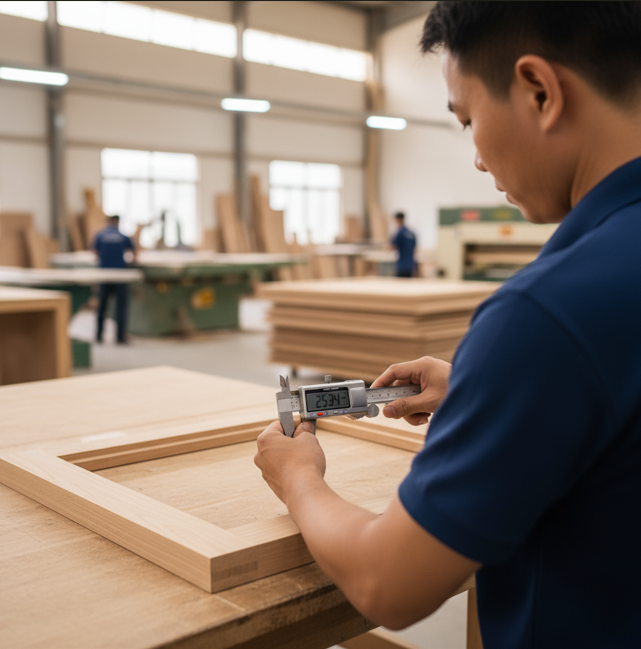
- Establishing Tolerance: Define acceptable limits. For example, what is the acceptable variance in color (+/- 5%)? What is the tolerance for a gap in a miter joint (e.g., < 0.5mm)?
Why it’s critical: The PPM eliminates ambiguity. It ensures the factory doesn’t make incorrect assumptions and provides a clear, documented standard against which to measure the entire production run.
2. Stage 1: Incoming Quality Control (IQC)
Quality issues often start with substandard materials. Incoming Quality Control is about catching these problems before they enter the production line.
- The Goal: To verify that all raw materials and components meet the agreed-upon specifications.
- Key Checks:
- Timber and Panels: Is the wood species correct? Is the moisture content within the acceptable range (crucial for preventing warping)? For MDF/particleboard, is it from the approved, CARB-compliant supplier?
- Hardware: Are the hinges, slides, and handles from the correct brand and model number specified in the BOM?
- Finishing Materials: Does the paint or lacquer match the approved control sample?
Why it’s critical: Using the wrong grade of plywood or a non-compliant board can compromise the entire order. IQC is the firewall that prevents these fundamental errors from derailing your production.
3. Stage 2: In-Process Quality Control (IPQC)
This is where you monitor the product as it’s being made. IPQC involves having inspectors on the factory floor at key stages, such as after cutting, after assembly, and after finishing.
- The Goal: To identify and correct deviations from the standard as they happen, rather than finding hundreds of faulty parts at the end.
- Key Checks:
- Machining: Are dimensions accurate according to the drawings? Are drilled holes in the correct position?
- Assembly: Are joints tight and square? Is adhesive applied correctly?
- Sanding & Finishing: Is the surface sanded smoothly, with no defects, before finishing? Is the color application consistent?
Why it’s critical: This is the most effective way to ensure consistency. If a machine setting is wrong, an inspector can catch it after the 10th piece, not the 1,000th. This saves immense time and material, and is a hallmark of a mature quality management system.
4. Stage 3: Final Quality Control (FQC) / Pre-Shipment Inspection (PSI)
This is the final check that most people are familiar with. It is performed once the order is 100% complete and at least 80% packed. Using a statistical sampling plan (like AQL – Acceptable Quality Limit), an inspector randomly selects a number of cartons to perform a full audit.
- The Goal: To provide a final, comprehensive assessment of the order’s quality and confirm it is ready to ship.
- Key Checks:
- Product Conformance: The inspector checks the product against the Golden Sample and tech pack for aesthetics, dimensions, construction, and functionality.
- Packaging: Is the carton correct? Is the shipping mark accurate? Is the product adequately protected? Is the instruction manual and hardware packet included?
- Carton Drop Test: A physical test to simulate the rigors of shipping and ensure the packaging holds up.
Why it’s critical: This is your final chance to catch any issues before the product leaves Vietnam. A detailed PSI report, complete with photos, gives you the clear evidence needed to either approve the shipment or demand corrective action from the factory.
Your Partner in Quality
Implementing a multi-stage QC process requires expertise, diligence, and a constant presence on the ground. It requires a partner who can speak the factory’s language while enforcing your brand’s standards.
At Mary Pham Sourcing, we don’t just find factories—we manage them. Our QC process is built on this proactive, multi-stage philosophy. We act as your eyes and ears, embedding quality into the manufacturing process from day one to ensure that what you receive is not a surprise, but a certainty.
Tired of quality issues derailing your production schedule? Let’s talk about how a structured QC process can bring predictability and peace of mind to your furniture sourcing in Vietnam.